

Earn Your Degree Without Textbook Costs
Our Associate in Arts degree with an Anthropology emphasis is now available as a Z Degree. You can earn the degree 100% online with zero textbook cost.
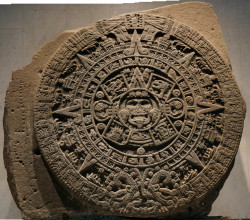 Aztec Sun Stone at Anthropology Museum, Mexico City
What is Anthropology?
"Are you as interested as I am in knowing how, when, and where human life arose, what the first human societies and languages were like, why cultures have evolved along diverse but often remarkably convergent pathways, why distinctions of rank came into being, and how small bands and villages gave way to chiefdoms and chiefdoms to mighty states and empires?" Marvin Harris, Our Kind.
If so, then the field of anthropology may be for you. Anthropology is not just an attempt to discover what it is that humans do and have done in the past, but also an endeavor to learn what it really means to be human in a sense of culture, biology, relatedness, and history. Anthropology is an effort to understand this broad sense of humanness and is divided into four major subdisciplines, each focusing on a different aspect of what makes us human.
The subdisciplines of anthropology are:
- Social/Cultural Anthropology: the study of human social and cultural behavior;
- Linguistics: the study of human language, its construction, and how it is used in societies;
- Physical or Biological: the study of human biological diversity, primate behavior, and evolution of humans over time (paleoanthropology);
- Archaeology: the study of the human past through material remains with the aim of reconstructing, ordering and describing the daily life, customs, and events of past people.
Collectively these disciplines provide anthropology with a background of information that helps us build a wide-ranging understanding of humanness itself. It would not be possible to fully appreciate what makes us human without this broad and holistic perspective.
Anthropologists also look for similarities and differences between people and their cultures by using a cross-cultural approach to answer questions. For example, from studying cultures around the world, we know that every culture is ethnocentric; that is, they believe their way of life, their values, and their worldview is superior to all others. The question is why do cultures take this perspective? The answer appears relatively simple. If we believe our way of life is better, then we simply reject anything foreign that comes along. Anthropologists would explain that cultures adopt attitudes and behaviors that have helped people in that culture to adapt; in other words, beliefs and values that have helped people in that culture to survive and reproduce through generations.
It has been said that the task of the anthropologist is to "make the strange familiar, and the familiar strange." We do so by studying people and their cultures, around the world and throughout time, comparing and contrasting them, and seeking to answer the question of what it means to be human.