Exploration of World View of the Quiche Maya

The Quiche Maya of highland Guatemala envisioned the eve of creation in a somber and awesome setting. Only in the popol Vuh-as eloquently the translated by Dennis Tedlock of State University of New York at Buffalo -we travel with them back to the beginning of time sky alone is there.... only the sea alone is pooled under all the sky; there is nothing whatever gathered together." Primeval matter lies in repose. "Whatever might be is simply not there: only murmurs, ripples, in the dark, in the night."

Within shadowed waters resided a god, Sovereign Plumed Serpent, "enclosed in quetzal feathers, in blue-green." The celestial god, Heart of Sky, also called Hurricane, descended and joined him, "and they talked, then they thought, then they worried." The gods devised their plan of the universe, of living things. "For the forming of the earth they said 'Earth.' It arose suddenly, just like a cloud, like a mist, now forming, unfolding."

Although Maya versions of creation-as well as other points of religionvary with place and time and have survived in segments that often prove unclear and confusing, all hold certain basic concepts. Through architecture, art, ancient inscriptions, colonial chronicles, and modern lore, Maya beliefs unfold.

They saw the surface of the land the gods created as the back of a supernatural creature floating in a vast sea. Some envisioned this living land-being as a caiman; others likened it to a turtle.

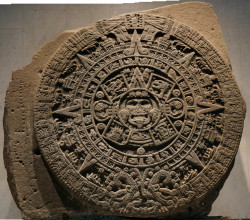
All ancient Indians of Mesoamerica shared a general culture. They also shared many myths. Aztec chronicles speak of cycles of earth's destruction and rebirth. According to them, earth has been created and destroyed four times, and we now live in the fifth world. One colonial Maya chronicle from Yucatan, The Book of Chilam Balam of Chumayel, also describes multiple creations. After one, it says, there was a great deluge and the sky fell to earth. Now four gods called Bacabs stand at earth's corners and hold up the sky.

Before they created the earth, the gods thought and they worried, said the Quiche. Then "they conceived the growth, the generation of trees, of bushes, and the growth of life, of humankind, in the blackness. And once the gods had brought forth the earth, "they planned the animals of the mountains, all the guardians of the forests, creatures of the mountains: the deer, birds, pumas, jaguars, serpents, rattlesnakes, yellowbites, guardians of the bushes." Yet the gods had not yet brought their ideal into being, for the animals "just squawked, they just chattered, they just howled." And so the gods experimented, creating and destroying until they had made a human design, one that could "speak, pray to us, keep our days." They populated the earth with tribes, and then "the sun, moon, and stars appeared, when it dawned and cleared on the face of the earth, over everything under the sky."

The Maya gods had set about their creation using a measuring cord, "halving the cord, stretching the cord in the sky, on the earth, the four sides, the four comers.... In doing so, they laid out an organized world: Earth's surface formed a horizontal plane, and each angle lay in a sacred cardinal direction. The Maya assigned a tree, herb, bird, color, and gods to each. East was red, the direction of the rebirth of the rising sun. West was black, the place of the sun's death and descent. White represented north, and yellow, south. A fifth direction- up and down- lay at earth's center. The color there was blue-green, and there grew a giant ceiba, or silk-cotton tree. It united the Maya universe. Its roots reached down into the forbidding Underworld. Its trunk stretched up from earth into the heavens, and with two branches, one on either side, it formed a kind of cross.

The Maya thought in terms of pairs, of opposites forming a complete and living universe driven by cycles of life, of time. Thus, there were male and female, night followed day, seasons alternated wet and dry, and inevitably death completed life. As there were thirteen tiers of heaven, so nine layers formed the Underworld that lay beneath the surface of the earth. The Maya thought it a dark and miserable place of pestilence and putrefaction ruled by the nine Lords of the Night. Into this realm-sometimes called Xibalba-the dying sun descended at twilight to endure untold dangers during its nightly passage, until, with good fortune, it triumphed and rose reborn at dawn to begin its daily journey across the heavens. Deceased rulers also traveled this treacherous path and, like the night sun, rose again-as deities. In death, the ordinary Maya, however, had little hope of ever escaping Xibalba.

John B. Carlson of the Center for Archaeoastronomy in Maryland writes, of another Mesoamerican culture: "The Aztec cosmos apparently had thirteen layers of Upperworld and nine layers of Underworld, with the Earth's surface as the first layer in both schemes." He points out that for all ancient Mesoamericans this "emphasizes the function of Earth and the world of man as the interface between worlds dominated by lords of the day and lords of the night."

For the Maya, then, earth's surface lay at the center of the universe and served as its anchor. But all three of these domains were interdependent parts of the whole cosmos, not separate entities. just as the earth was alive, so were the sky and the Underworld. Robert J. Sharer of the University of Pennsylvania writes: "The world of the ancient Maya was governed by a cosmological order that transcended our distinction between the natural and supernatural realms. All things, animate or inanimate, were imbued with an unseen power."

"This is a native American worldview," says anthropologist Peter T. Furst, also of the University of Pennsylvania. "It is Pan-American, this concept of the supernatural and the human relationship to nature. There was a belief in human transformation. The ecstatic trance was the peak religious experience. In this way, both in tropical South America and in Mesoamerica, a shaman, in essence, became a jaguar. Plants played a major role in these trances -and there were some 40 hallucinogenic ones in use in Mesoamerica."

The earth, with its plants and creatures and its physical features, was an awesome and sacred landscape. From myths and tales we know that a rock or a tree might be inhabited by a spirit; deities could live in the depths of mountains. Along with predatory jaguars and deadly serpents, ghosts prowled the night; spirits roamed the forests, waiting with eerie danger on certain ill winds. All things joined in a unity of life, in a communion, each a part of the other.

It is said that a hunter in Yucatan would appease the god who protected deer with an offering of corn gruel, explaining his aggression to his fallen prey-"I had need." The Maya went beyond sharing the physical world with animals. Humans they believed, had animal "co-essences." A ruler's creature-companion was the jaguar. William L. Fash, of Northern Illinois University and Director of the Acropolis Archaeological Project at Copan, writes: "The jaguar was considered to be the intermediary between the world of the living and the world of the dead, and a protector and symbol for the Classic Maya royal houses." In 1988, excavations next to Altar Q at Copan, which portrays 16 kings of the royal dynasty, revealed an astonishing find: In A.D. 775, 15 jaguars had been sacrificed by the ruler Yax Pac and buried in a masonry crypt-a jaguar for each of his royal ancestors.

Two of the most sacred features of the landscape served as transitions between the physical world and the spirit world. These were mountains and caves, a Mesoamerican concept already ancient when Maya culture developed. Some symbols on temples and pyramids proclaim them man made mountains and centers of power. And a temple doorwa represented a cave leading into the center of that mountain -and into the Underworld. The Maya believed the entrance to the Underworld lay in the gaping maw of the reptilian earth-creature, and they likened the mouths of caves to it. Visit one of these mystical thresholds and you understand the Maya concept. In a searing and brilliant tropical noon, the chasm leading into Yucatan's Loltun Cave yawns with the rush of sudden and silent cold air, like exhalations from the dead. Ever-darkening tunnels lead downward and into a world of no light, hidden chambers, astounding stalactites and stalagmites, and water.

In the northern highlands, rivers often rush through mountain valleys only to disappear suddenly into an enormous earthen mouth. A network of underground rivers flows in unending darkness. Through black streams and in cave pools swim pale fish without color and with atrophied eyes. Shrimps, sightless and startlingly transparent, feel their way through liquid depths, searching. In the mountains of Guatemala, modern Maya still call one fearsome cave Xibalba. The Popol Vuh recounts the story of twins who journeyed to Xibalba. For the Maya, their round of adventures serves as a metaphor for timeless, repeating cycles and for the regeneration of earth and all living things.